
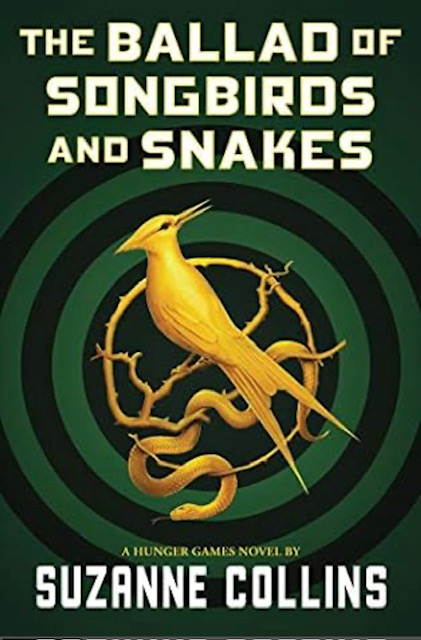
The Ballad of Songbirds and Snakes by Suzanne Collins
November 9 - November 11 2023
 4/5
4/5
E-book
YA, Dystopian, Sci Fi/Fantasy, Romance
Review
This was a very intriguing book, particularly as a villain origin story. Overall, I really enjoyed it, particularly all of the little (or big) details connecting back to the original trilogy, the seeming inconsistencies of Snow's thoughts and narration, as well as the background and history of Panem and the games. Given what I know of the Hunger Games books, I was expecting more prolonged action throughout the book and I would've loved to have learned more about Lucy Gray.
Spoilers
She is by far the most mysterious character throughout the novel, and while her story makes sense given Snow's perspective and the song inspiring her name, I always want more answers when it comes to ambiguous endings. When did she realize Snow was bad news? Did she truly feel affection for Snow, or was she playing him from the start like the performer she is? Did she start to connect the dots back in District Twelve or not until the very end? I found her a captivating character, but so much of that is tied up in what we don't know about her and how much we might be missing because of Snow's bias.
The timeframe for this book takes place during the 10th Hunger Games. From what I know of the movie, I thought this was the first televised games. While that assumption wasn't correct, this is when the Capitol began to truly market the games as a spectacle. This is the year they introduce the mentor program, and who better to use than the nearly grown students who spent their childhood in the war and grew up in the aftermath? We also get a brief introduction to Lucky Flickerman, Caesar Flickerman's ancestor and first host of the games as they introduce the interview portion. Aside from being tasked with marketing children around their age to Capitol citizens for their own personal standing and success within the Academy, the students are also tasked with drawing engagement, which is where Snow comes up with the idea of sponsorships and betting. He also draws attention to the impoverished conditions the tributes are kept in. Unlike the lavish opulence Katniss and Peeta were forced to experience before being sent to die, the tributes for these games are starved and kept in the old monkey cage at the zoo. It's only through the mentors' attempts to feed them garner sympathy from Capitol residents on their tributes' behalf, or by the tributes performing, do they get to eat before fighting for their lives. The casual cruelty of the gamemakers, peacekeepers, mentors, and Capitol citizens provides an interesting comparison to the spectacle and commercialization that we know the games to become.
Aside from witnessing how the games developed to more interactive tv entertainment, the majority of this book focuses on the development of our antagonist: Coriolanus Snow. He's a very unique character, given his villain status. His character and story is full of strange, almost contradictions. In those times you might feel sympathy for him or can see the outlines of a redemption arc. Until you keep reading and it all falls to pieces. Snow constantly reflects back on the hardship his family faced during the war, as well as the poverty they face currently. Living off of his cousin Tigris' meager wages, the only reasons the Snows have been able to save face is through the prestige of their family name as well as the ownership of the family house and some of their former luxury items. Yet, rather than humbling him, Snow absolutely disdains any hint of poverty and hates anyone who he feels profits undeservedly.
Spoilers
This includes jealousy over Serjanus Plinth, his so-called best friend who used to be District before moving to the Capitol, with all the riches and opportunities the Snows should have. He has the district-sympathizer "friend," a struggling childhood, a whirlwind romance with a girl from District 12, as well as seemingly undeserved hatred from the Headmaster and the cruel testing of head gamemaker Dr Gaul. All of these factors would seem to facilitate some measure of redemption, but not in Coriolanus Snow. He continues to believe that the Districts are animals and beasts. Lucy Gray is merely an exception, but still very clearly a possession he owns regardless of his professed love for her. Despite his own acknowledgements that Dr. Gaul is cruel and his laughing at some of the Capitol's propaganda (like calling Arachne a national hero because she was murdered for taunting a starving tribute with food), he still buys into their ideology. The Capitol bring order and control to a race that would otherwise descend into madness and violence. The war never ends and the only way to control it is to contain it in small amounts through the Hunger Games. Living wild and free, whether through nature or humans, is deeply disturbing to him. "...something about the mockingjays repelled him. He distrusted their spontaneous creation. Nature running amok. They should die out, and die out soon." There are instances where he finally seems to be making some progress, like recognizing some similarities in how he and Lucy were forced to grow up, or the cruelty of Dr. Gaul, or trying to imagine himself in the tributes' shoes like Serjanus does. But all too quickly he brushes it off. His whole experience with Lucy Gray, the 10th Hunger Games, and his job as a peacekeeper, are swept under the rug in favor of his work to revitalize next year's games, murder the headmaster, and continue to move up in the world. He even brushes off his relationship with Lucy so fast once he realizes she's the last person standing between him and his future. The change there happens so fast too. I would've expected more of a betrayal or confrontation, but the whole thing seems so very inconsequential compared to everything else in the books. After all, "Snow falls on top."
I do also want to take a moment to acknowledge all of the connections to the "Hanging Tree" that we get in Part 3 of the book. I was so excited when I started making all of those connections only for Lucy to start writing the song a few pages later. It adds a whole new layer of meaning to Katniss and the rebellion's rendition all those decades later. I also think the connection between Coriolanus, Billy Taupe, and Lucy Gray provides an interesting twist on Peeta, Gale, and Katniss. Lucy Gray and Katniss are clearly meant as inverse reflections of each other: Lucy as a performer forced to fight for survival, and Katniss a survivor forced to perform to live. Billy, however, with his grand ideas of running away with Lucy and small acts of rebellion, reminds me a lot of Gale's own plans. Does that make young Snow a weird reflection of Peeta? Both charismatic boys who are capable of charming and manipulating public/media perception, falling in love and gaining the trust of a very formidable girl from District 12. Obviously, Peeta is a much better person than Snow, despite what Coriolanus believes of himself. But I think the twisted parallels offer a lot to think about and analyze.
Content Warnings
Mentions or depictions of:
violence, death, murder, cannibalism, death of parent, war